


Spend enough time looking at successful app companies and a question begins to emerge. Why do organisations operating in broadly the same industry often build such different leadership teams?
Compare companies like Spotify, Revolut, Flo, Deliveroo or Duolingo and the differences quickly become apparent. Some invest heavily in product leadership early on. Others build around engineering. Some place enormous emphasis on growth, while others develop specialist teams around data, trust and safety or customer success much sooner than you might expect.
There is no single blueprint, which is perhaps why copying another company's organisational structure rarely works. Leadership teams tend to reflect the problems a business is trying to solve at a particular moment in its journey, rather than following a standard template.
Having worked with technology businesses for many years, we've noticed that the strongest app companies usually evolve their leadership teams in recognisable stages. The exact titles and reporting lines may differ, but the underlying pattern is surprisingly consistent. New leadership capability appears when the business reaches a point where the existing team can no longer comfortably carry the load.
Growth Changes What Leadership Looks Like
In the earliest stages, founders often wear almost every hat. Product decisions, hiring, fundraising, commercial partnerships and culture may all sit with just a handful of people. As the company grows, that arrangement becomes harder to sustain. New functions emerge, decisions become more specialised and experienced leaders are brought in to create focus where generalism once worked perfectly well.
This article explores how that evolution often unfolds. Every company follows its own path, but there are enough common themes to provide a useful framework for founders thinking about their next executive hire and for leaders curious about how app organisations typically scale.
The First Leadership Team Isn't Built for the Last
One of the biggest mistakes founders can make is assuming they'll eventually arrive at the "correct" organisational structure. In reality, leadership teams are constantly evolving. The company changes, the challenges change and, as a result, the people around the table often change too.
A founder who excels at taking a product from concept to product-market fit may discover that leading a business with 300 employees requires a very different set of skills. Equally, an executive who thrives in a large, established organisation may struggle in a business where priorities shift every week and resources are limited.
The goal is not to build tomorrow's leadership team today. It's to build the right leadership team for the stage your company is entering.
That usually means introducing experience only when the business genuinely needs it. Hire too early and you risk adding unnecessary complexity. Wait too long and founders can find themselves stretched across too many functions, slowing decision making just when the company needs to move faster.
Looking across successful app companies, there are some surprisingly consistent patterns in how this evolution unfolds. The exact timing varies, but the broad progression tends to be remarkably similar.
The Founding Team
Every app company starts out trying to answer a handful of deceptively simple questions. Does anybody actually want this product? Will people come back? Can we persuade enough users to pay for it, or build a large enough audience to support the business in another way?
Those questions shape the first leadership team. At this stage, founders are usually solving problems themselves rather than building functions around them. A CEO might spend the morning pitching investors, the afternoon interviewing engineers and the evening replying to customer emails. A technical founder may still be writing production code while helping define the product roadmap.
Titles can be surprisingly misleading. Someone called "Head of Product" may also be leading design, analysing user data and writing marketing copy. Responsibilities overlap because they have to. The priority is learning quickly rather than creating clear organisational boundaries.
This is often one of the most exciting periods in a company's life. Decisions happen quickly, communication is informal and everyone has a direct line to the founders. The organisation is small enough that context spreads naturally, without much process getting in the way.
As the company grows, the nature of the work begins to change. More customers create more support requests. More employees require more structured hiring and people management. More revenue brings greater financial complexity, while larger engineering and product teams need clearer ownership and coordination. Roles that were once broad naturally become narrower and deeper, allowing leaders to develop greater expertise within their own areas. The leadership team starts to expand, not because the founders have become less capable, but because the business itself has become more complex.
The Shift Towards Specialisation
One of the most noticeable changes as app companies grow is the gradual move away from generalists. In the early days, almost everyone wears several hats. By the time a company has established a successful product and is beginning to scale, that becomes much harder to sustain.
Take product management as an example. A founder who once made every product decision may now be working with multiple product managers, each responsible for a different part of the user journey. Engineering follows a similar path, with teams becoming large enough to require dedicated technical leadership alongside the CTO.
The same pattern can be seen across the organisation. Finance evolves from bookkeeping and cash management into forecasting, budgeting and investor reporting. Recruitment gradually becomes a broader people function. Customer support develops into a larger operation focused not only on solving problems, but understanding them and feeding those insights back into the product.
What is interesting is that these functions rarely appear overnight. They tend to evolve organically, with responsibility moving from founders and generalists to leaders who can devote their full attention to a particular area of the business.
There is no fixed sequence. Every company reaches these moments at different times. A fintech business may strengthen finance and compliance relatively early, while a consumer subscription app may invest sooner in growth, experimentation or data science. The underlying principle is usually the same. As individual functions become more important, they begin to justify dedicated leadership.
Product, Growth and Data Become the Engine Room
As app companies mature, product, growth and data often become increasingly difficult to separate. Each function may have its own leaders, teams and priorities, but the most effective organisations tend to connect them closely.
Product teams decide where to improve the experience and which customer problems are worth solving. Growth teams work out how to attract users, encourage them to engage and give them reasons to return. Data teams help both sides understand what is actually happening, often challenging assumptions that might otherwise have gone untested.
Apps are particularly well suited to this way of working because almost every interaction leaves a trail. Companies can see where users abandon an onboarding journey, which features encourage repeat usage, how different customer groups behave and whether a new release has improved retention. Marketing activity can be measured with similar precision, from the cost of acquiring a user to the revenue they may generate over time.
This creates a constant flow of information between marketing analytics and product analytics. A campaign may bring in a large number of new users, but product data reveals whether they stay. A feature may increase engagement among existing customers, while marketing analysis helps identify which audiences are most likely to value it. Neither side tells the full story on its own.
As the volume and complexity of that information grows, analytics itself begins to specialise. Generalist analysts may be joined by dedicated product analysts, marketing analysts, analytics engineers and data scientists. More mature teams can begin to build models around churn, customer lifetime value, recommendations, fraud, pricing or demand forecasting.
The result is usually a more disciplined approach to decision making. Ideas can still begin with instinct, experience or creative judgement, but they are increasingly tested against evidence. Over time, the ability to understand user behaviour and turn that understanding into better product and marketing decisions becomes one of the most important capabilities in the business.
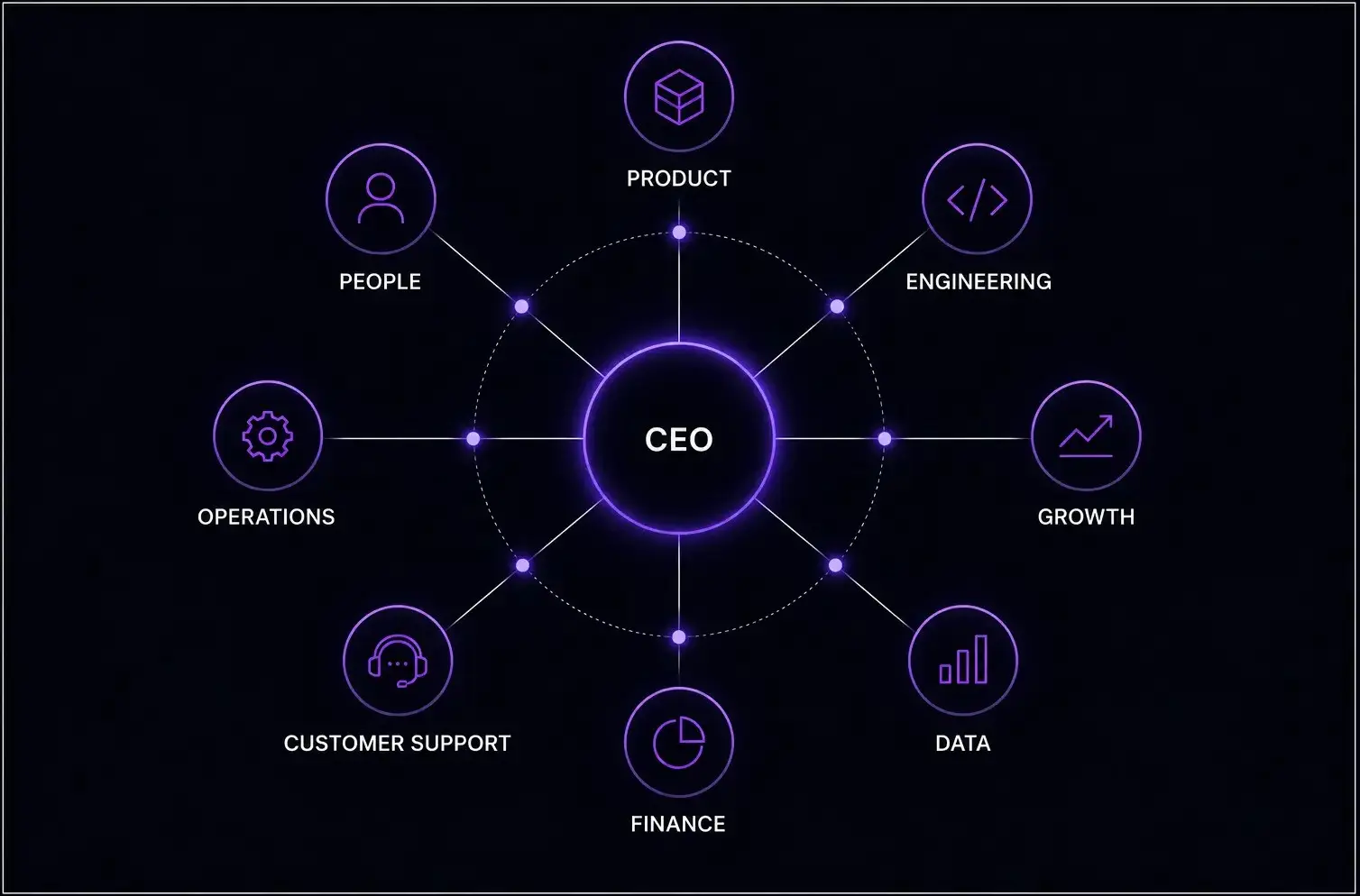
The Functions That Become More Important With Scale
Some functions grow in importance more quietly. Customer support and people leadership may receive relatively little attention in the earliest stages of an app company, but both can become central as the user base and organisation expand.
Customer support is a good example. When a company has a small number of users, founders and product managers may handle queries themselves. That direct contact can be extremely valuable, giving the team an unfiltered view of what customers like, where they struggle and which problems appear repeatedly.
As the customer base grows, support becomes a much larger operation. The challenge is no longer simply responding to individual tickets. Teams need to identify recurring issues, improve response times, build effective self-service tools and make sure customer feedback reaches the people responsible for the product. In subscription and marketplace businesses, support can also have a direct influence on retention, trust and the overall reputation of the app.
The people function develops in a similar way. Early recruitment is often led by founders and hiring managers, with culture shaped informally through the people they choose to bring into the business. That can work well while the company is small and everyone knows one another.
Growth introduces a different set of demands. Recruitment becomes more continuous and specialised. Managers need support with performance, feedback and difficult conversations. Employees expect clearer development opportunities, while leadership teams need a more deliberate approach to learning, succession and retention.
Employer branding also begins to matter more. A growing app company may be competing for engineers, product managers, designers and data specialists against businesses with larger recruitment teams and better-known brands. The employee experience becomes part of how the company attracts talent, not simply something considered after people join.
At this point, HR is no longer mainly an administrative function. It becomes part of the machinery that allows the organisation to keep growing without losing clarity, capability or culture along the way.
Engineering Becomes an Organisation in Its Own Right
Most app companies begin with a small engineering team focused on one objective: building a product that people want to use. Speed matters far more than structure. Communication is informal, technical decisions happen quickly and everyone usually understands every part of the codebase.
As engineering teams grow, that simplicity gradually disappears. More developers mean more coordination, clearer ownership and greater technical consistency. Team leads emerge, specialist engineering managers are introduced and architects begin thinking further ahead than the next product release.
The work itself also changes. Infrastructure becomes more sophisticated, security takes on greater importance and platform engineering, quality assurance, developer tooling and site reliability often evolve into dedicated disciplines. Engineering leadership is no longer focused solely on shipping features. It is also responsible for ensuring that the organisation can continue to build quickly as both the product and the team become more complex.
This is often the point at which leadership responsibilities begin to divide. In some organisations, the CTO remains deeply involved in technology strategy while engineering managers oversee the day-to-day running of delivery teams. Others introduce a VP Engineering or Head of Engineering to focus on execution, allowing the CTO to concentrate on architecture, innovation and longer-term technical direction.
Exactly where those responsibilities sit varies from one company to another, but the underlying pattern is familiar. As the engineering organisation expands, leadership becomes less about writing code and more about creating an environment where hundreds of engineers can work effectively together.
Common Leadership Mistakes
There is no perfect formula for building an app leadership team, but certain mistakes appear with surprising regularity. They often stem from trying to solve tomorrow's problems too early or yesterday's problems for too long.
One common trap is hiring leaders who are more comfortable managing large organisations than building growing ones. An executive who has spent years overseeing established teams inside a global technology company may struggle in an environment where priorities change weekly and processes are still being invented. Early-stage companies usually need people who are happy to roll up their sleeves rather than simply coordinate the work of others.
Founders can also place too much emphasis on brand names. Experience at companies such as Google, Meta or Amazon can be hugely valuable, but it is not a guarantee of success. The best candidates are rarely successful because of the logo on their CV alone. What matters is whether they have solved similar problems at a similar stage of growth and can adapt to the pace and ambiguity of a scaling business.
Another mistake is sending the wrong signal about the importance of a function. Organisational structures communicate priorities, and unusual reporting lines can sometimes undermine areas that should have an independent voice. Product reporting into finance, engineering reporting into operations or people reporting several layers away from the executive team may all make sense in specific circumstances, but they should be deliberate decisions rather than historical accidents.
Job titles deserve similar thought. It can be tempting to hand out C-level titles in the early days as a way of recognising key employees or helping attract talent. The downside often appears later. As the business grows, introducing genuinely executive-level hires becomes more difficult, while opportunities for internal progression become limited because people have already reached the top of the title ladder.
Perhaps the most difficult transition of all is for founders themselves. The habits that help build an app from nothing, staying close to every decision, reviewing every feature and maintaining oversight of every function, can become constraints as the organisation grows. Great founders rarely become less ambitious as their companies scale. The challenge is learning where their involvement creates the most value and where trusting experienced leaders allows the business to move faster.
Conclusion
The best app leadership teams are rarely built in a single step. They evolve as the business evolves, with new capabilities emerging in response to new challenges. The right structure for a company of twenty people is unlikely to be the right structure for a company of two hundred, and successful founders recognise that organisational design is an ongoing process rather than a destination.
While every app company follows its own path, certain patterns appear again and again. Product, engineering, growth and data become increasingly specialised. Customer support and people leadership grow in strategic importance. Financial, commercial and operational complexity demand deeper expertise. The leadership team expands not because earlier leaders have failed, but because the business itself has become more sophisticated.
For founders, one of the most important decisions is not simply who to hire next, but when. Introducing new leadership too early can create unnecessary complexity. Waiting too long can slow the organisation just as momentum begins to build. Striking the right balance is rarely straightforward, but it is often one of the defining characteristics of companies that scale successfully.
There may never be a perfect blueprint for building an app leadership team, and that's probably a good thing. Every company is different. Every market presents its own challenges. The organisations that build the strongest leadership teams are usually those that understand where they are today, recognise where they need to be tomorrow and add the capabilities that help bridge that gap.
Explore Neon River
Learn more about our Apps executive search practice and our experience working with high-profile entrepreneurs .